

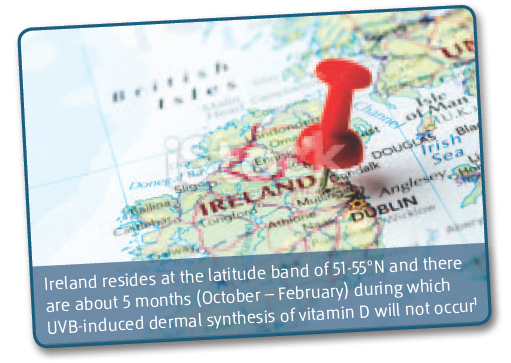
The role of vitamin D and the treatment of vitamin D deficiency

Vitamin D deficiency

“There is widespread acknowledgement of the presence of vitamin D deficiency in the community and the pressing need to address this deficiency.”¹
— Prof. Kevin Cashman, UCC, commenting on the results of the Irish NANS Study 2013.

The North American Institute of Medicine (IOM)’s DRI Committee for calcium and vitamin D proposes a serum 25(OH)D concentration of 50 nmol/L that would meet the needs of 97.5% of normal healthy persons.¹

In agreement with the Scientific Advisory Committee on Nutrition (SACN)² report, the Royal Osteoporosis Society (ROS)³ in the UK proposes vitamin D thresholds as follows:

  • Plasma 25(OH)D < 25 nmol/L is deficient

  • Plasma 25(OH)D 25–50 nmol/L may be inadequate in some people

  • Plasma 25(OH)D > 50 nmol/L is sufficient for almost the whole population

The Endocrine Society Clinical Practice Guideline defines vitamin D deficiency as 25(OH)D below 50 nmol/L and vitamin D insufficiency below the range of 52.5–72.5 nmol/L.⁴

The American Geriatrics Society Consensus Statement on Vitamin D for the Prevention of Falls and their Consequences recommends that a serum 25(OH)D concentration of 75 nmol/L should be a minimum goal to achieve in older adults, particularly in frail adults who are at greater risk of falls, injuries, and fractures.⁵

The guideline statement from the Scientific Advisory Council of Osteoporosis Canada states that the optimal serum 25-hydroxyvitamin D (25OHD) level for bone health is uncertain; however, ≥50 nmol/L is generally considered adequate for bone and overall health in healthy individuals.⁶

The American Academy of Pediatrics (AAP) states that serum concentrations of 25(OH)D in infants and children should be at least 50 nmol/L.⁷


The Canadian Paediatric Society defines deficiency as serum 25(OH)D levels <25 nmol/L, insufficiency as 25–75 nmol/L, but highlights a range of 75–225 nmol/L as optimal for parathyroid hormone production, minimisation of bone resorption, and stabilisation of intestinal calcium absorption.⁸

The Evidence-Based Recommendations from the Cystic Fibrosis Foundation, published in JCEM (2012), recommend a minimum serum 25(OH)D level of 75 nmol/L for people with cystic fibrosis.⁹
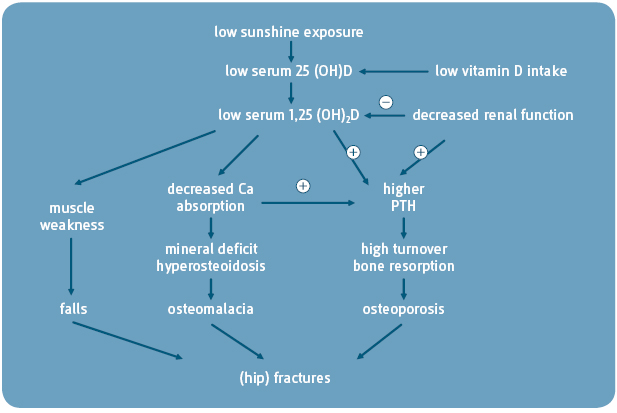
Clinical Features of Vitamin D Deficiency

Osteomalacia and vitamin D deficiency treatment

  • In young children, who have little mineral in their skeleton, vitamin D deficiency results in a variety of skeletal deformities classically known as rickets
  • In adults, the epiphyseal plates are closed and there is enough mineral in the skeleton to prevent skeletal deformities so that this mineralisation defect, known as osteomalacia, often goes undetected5
  • However osteomalacia causes a decrease in Bone Mineral Density (BMD) and is associated with isolated or generalised aches and pains in bones and muscles

Osteomalacia is softening or weakening of the bones due to a lack of vitamin D or due to a problem with the body’s ability to break down and absorb vitamin D.

  • Vitamin D deficiency causes muscle weakness
  • Affected children have difficulty standing and walking
  • The elderly have increasing sway and more frequent falls, thereby increasing their risk of fracture

  1. Cashman K et al. Vitamin D status of Irish adults: findings from the National Adult Nutrition Survey. British Journal of Nutrition (2013), 109, 1248-1256.
  2. Scientific Advisory Committee on Nutrition (SACN) Vitamin D and Health Report, 2016, P 1 – 285
  3. The Royal Osteoporosis Society (ROS). Vitamin D and Bone Health: A Practical Clinical Guideline for Patient Management.December 2018. V2.
  4. Holick M et al. Evaluation, Treatment, and Prevention of Vitamin D Deficiency: an Endocrine Society Clinical Practice Guideline. J Clin Endocrinol Metab; July 2011; 96(7): 1911-30.
  5. Recommendations Abstracted from the American Geriatrics Society Consensus Statement on Vitamin D for Prevention of Falls and Their Consequences. J Am Geriatr Soc 62: 147-152, 2014.
  6. Morin et al,  Appendix 1 2023 Guideline Supplementary Tables in  Clinical practice guideline for management ofosteoporosis and fracture prevention in Canada: 2023 update, CMAJ October 10, 2023 195 (39) E1333-E1348.
  7. Wagner C et al. Prevention of Rickets and Vitamin D Deficiency in Infants, Children, and Adolescents. Paediatrics Vol 122:No. 5 November 1, 2008, 1142-1152.
  8. Godel J et al. Recommendations for Canadian mothers and infants. Paediatr Child Health 2007; 12(7): 583-9, Reaffirmed January 2017.
  9. Tangpricha V et al. An Update on the Screening, Diagnosis, Management and Treatment of Vitamin D Deficiency inIndividuals with Cystic Fibrosis: Evidence-Based Recommendations from the Cystic Fibrosis Foundation. J Clin EndocrinolMetab April 2012, 97(4): 1082-1093.

IE-ALT-385(2) November 2025